Historically Grounded Christian Apologetics

Tag: two foundations

  • Title: 03. What is the Bible?

    Title: 03. What is the Bible?

    Verse: 2 Timothy 3:16-17 NASB

    “16 All Scripture is inspired by God and beneficial for teaching, for rebuke, for correction, for training in righteousness; 17 so that the man or woman of God may be fully capable, equipped for every good work.

    Summary/ TL;DR

    An ancient collection of books, divided into the Old and New Testament, beginning with the creation of mankind and finalizing with its judgement. Christians use the unity of the Old and New for scripture.

    Introduction

    What is the Bible? A commonly asked question, with varying answers due to differing perspectives. The “Historian” may use the Bible as a document to trace back historical events in a quest to dig into the past. The “Adventurer” may view the Bible filled with wonderful tales and thrills. The “Faithful” may use it as a resource to strengthen their relationship with God or to discover purpose. Others may view it through a more negative lens, as a collection of books of tribulations, darkness, and suffering. Regardless of how you view the Bible, it is the most influential book in human history.

    Body

    So what is the Bible? The name derives from the Greek term “biblia”, meaning books, or library. Therefore it is a collection of 66 books (Protestant Bible), written in 3 primary languages: Greek, Hebrew, and Aramaic, attributed to approximately 40 authors over a span of 1500 years. The Bible begins with Genesis, the beginning of creation and mankind, and ends with Revelation, the final judgement of mankind. The Bible is split into 2 divisions, the Old and New Testament, in other words, an old and new covenant (agreement) between God and his people. Judaism uses the Old Testament (the Tanakh) for their scripture, whereas Christians, who are under the New Covenant, use the unity between Old/ New Testaments as scripture.

    As previously mentioned in my Introduction post, our focus is on the New Testament. Jesus is the central figure of the Bible, being prophesied in the Old, and living out his ministry and church in the New. 

    The New Testament can be divided into itself, into 5 separate divisions:

    1. The Gospels (good news)
      1. Synoptics (general view, shares similar structure, events, wording)
        • Matthew
        • Mark
        • Luke
      2. Independent Account
        • John
    2. History
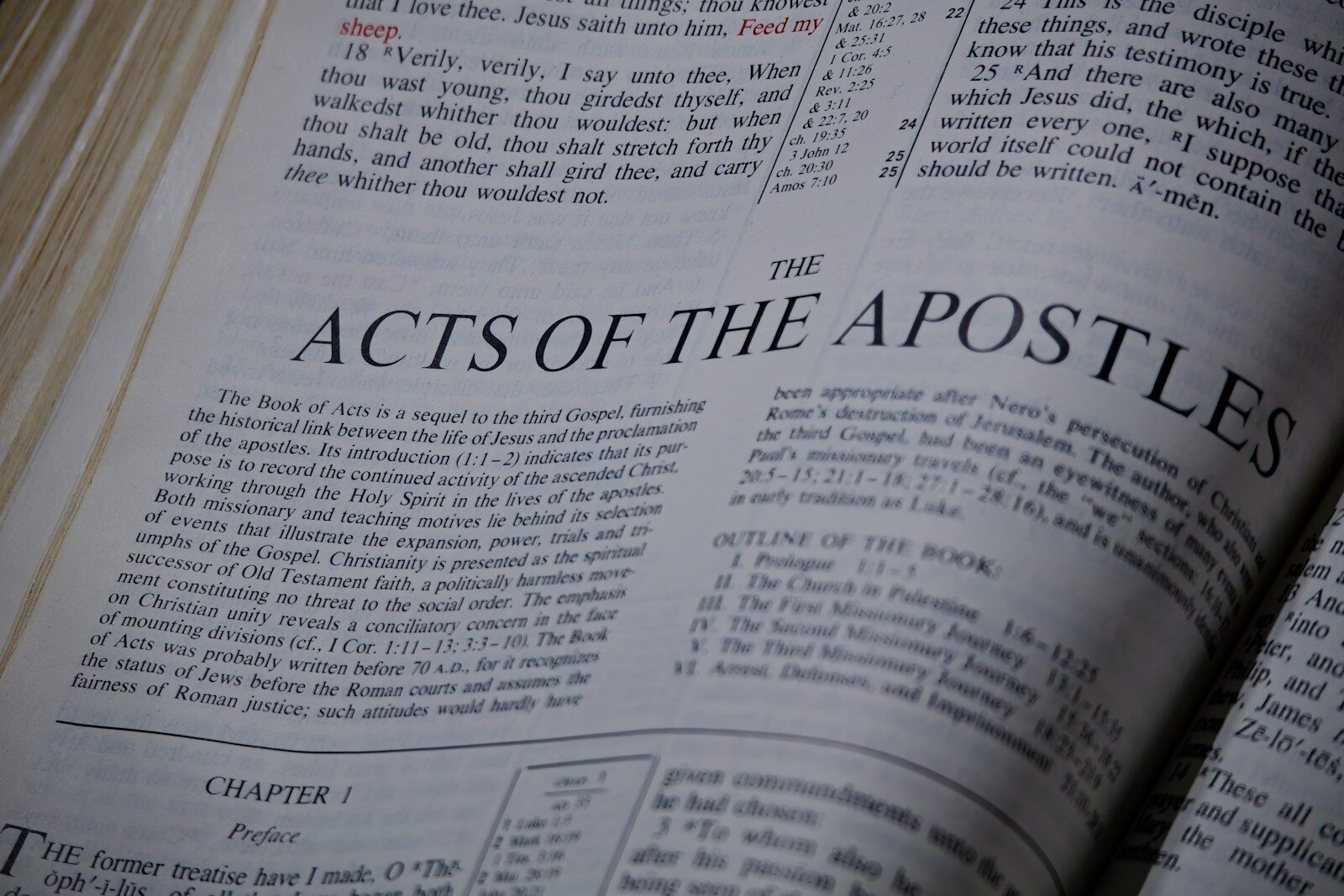
      1. Acts(of the Apostles)
        • Establishment of the Church, the acts of the Apostles
        • Attributed to Luke
    3. Pauline Epistles (letters to communities by Paul)
      1. Romans, 1 & 2 Corinthians, Galatians, Ephesians, Philippians, Colossians, 1 & 2 Thessalonians, 1 & 2 Timothy, Titus, and Philemon
        • Letters to targeted communities/ persons filled with teachings and theology
        • Attributed to Paul
    4. General Epistles (letters to communities)
      1. Hebrews, James, 1 & 2 Peter, 1, 2, & 3 John, and Jude
        • Letters to targeted communities/ persons filled with teachings and theology
        • Authors are connected to each epistle titles, Hebrews author remains unknown
    5. Prophecy
      1. Revelation
        • Judgement day, a salvation of mankind
        • Attributed to John the Apostle

    Throughout the blog, as it stands at the moment, most of the blog posts I’ll be writing about will be primarily focusing on The Gospels, followed by Acts. As mentioned in my 5 division breakdown, the Gospels and Acts remain rooted in history, as the remaining divisions primarily focus on teachings, theology, and events to come.

    Conclusion

    This post remains to be a brief overview, offering a general summary of what the Bible is, but future posts will hone in on specifics. That includes dating the Bible, who the authors were, historic locations and events, reliability, etc. For this blog’s identity, we’re the earlier mentioned “Historian”, and we seek to bring the past back to life. Let’s unravel the truth.

    Sources:

    https://www.gotquestions.org/what-is-the-Bible.html

    https://www.reviveourhearts.com/blog/how-is-the-new-testament-organized/?srsltid=AfmBOorlgZCDDLcz3On3i6-SXtkl-5sz7BnCxK9Hma5FwMHO4mSc0CN0

  • Title: 01. Introduction to two foundations

    Title: 01. Introduction to two foundations

    Verse: Matthew 7:24-27 NASB

    The Two Foundations

    Summary/ TL;DR: A historical Christian apologetics blog for Christians with doubt, skeptics, and atheists with an interest in biblical history, by a former atheist who came to faith researching the reliability of the New Testament.

    Introduction

    The parable of “The Two Foundations” found in Matthew 7:24-27, speaks of those who built their houses on rock and sand. When these houses were tested through flooding and storms, the house built on a foundation of rock remained. This blog serves to deliver a foundation built on rock to build your faith upon through stress testing, and when opposition arises, can withstand the pressures using historical and evidential sources. The Christian faith is rooted in history, and is not to be discarded as a blind belief.

    Body

    Christianity is built on historical events, locations and figures, but it seems any and all details of the Bible are questioned for their validity. This blog serves to answer these objections against biblical and historical reliability, by primarily using archaeology, ancient practices and written records from hostile and non-hostile sources. For instance, the crucifixion of Jesus of Nazareth by Pontius Pilate can be supported through ancient historians sources such as Tacitus and Josephus. This is an event that is built on rock, not of sand, that is widely accepted as a true historical event. This is not to say the resulting event, the resurrection, can be proven without a shred of doubt, the point is resistance to arising doubt.

    I want to stress that the brightest minds can come to conflicting results on Christianity. For instance, the late Bruce Metzger, and his student Bart Ehrman, both specializing in biblical textual criticism, ultimately arrived at different conclusions, with the former remaining a believer. As an ex-atheist myself, who came to faith well into adulthood, my personal journey and historical research convinced me that Christianity is true. That isn’t to say that my sceptical nature doesn’t still exist, as I’ve been designed to question and search for answers, but my scepticism has developed into a passion for seeking truth. My point is that Christianity, although being rich in history and evidence, still requires an abundance of faith.

    So why choose this blog? I’m no theologian, no degree in history, but a blue-collar convert who persistently asks questions, and ruthlessly searches for answers. This attitude has granted me a considerable amount of time researching the historical and reliability of the New Testament. The result has led me to reading and listening to both sides of the aisle, as I have sat on both, and peered through the lens of faith and doubt. Because of my conversion and worldview, I steer to where the evidence points, regardless of the aisle. I’m seeking answers honestly, and hope that will be reflected, as I’ll cover my “doubting Thomas” perspective throughout. As Christianity is a religion that welcomes investigation, I invite you into how I conducted my research.

    Conclusion

    Therefore let’s rip up these foundations built on sand, and seek answers left before us. Too often apologetics uses theology for their defense, but for atheists or skeptics alike, theology doesn’t apply when you don’t have an established belief in God in the first place. This blog serves to validate the Bible, focusing on the New Testament, to indicate that these weren’t just myths and legends that developed over time, but events that did occur. With that said, even with the evidence that will be provided, it will still require a leap of faith. The goal is to construct a solid footing before that leap, let’s begin laying out the groundwork.