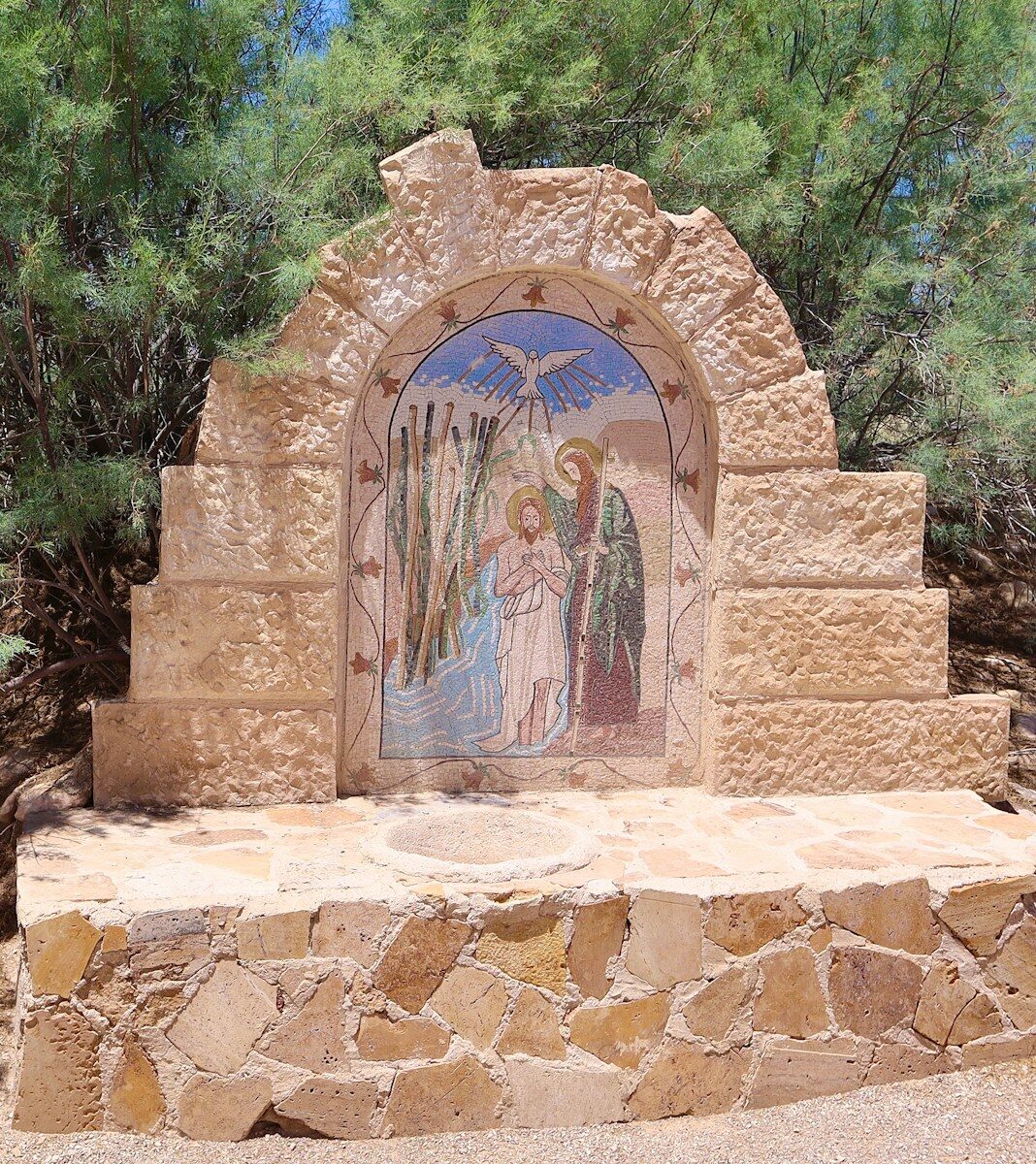
Verse: Matthew 3:14 NASB
14 But John tried to prevent Him, saying, “I have the need to be baptized by You, and yet You are coming to me?”
Summary/ TL;DR
Using internal textual analysis and external evidence, we can confidently conclude that Jesus of Nazareth was baptised by John the Baptist, in the Jordan river.
Introduction
There are many things that critical scholars deem as highly likely to have occurred regarding the “historical Jesus”. Some of these include the crucifixion, serving as a teacher, amassing a following, and another being the baptism by John the Baptist. It is written that Jesus, before his ministry began, was baptised in the Jordan River by John the Baptist. Once Jesus is baptised, this sets the wheels in motion of Jesus’s ministry, and even illustrates the unity of the trinity. This event is supported using external non-Christian sources, and textual analysis methods.
Body
Matthew 3:13-17 NASB 1995
The Baptism of Jesus
13 Then Jesus arrived from Galilee at the Jordan, coming to John to be baptized by him. 14 But John tried to prevent Him, saying, “I have the need to be baptized by You, and yet You are coming to me?” 15 But Jesus, answering, said to him, “Allow it at this time; for in this way it is fitting for us to fulfill all righteousness.” Then he allowed Him. 16 After He was baptized, Jesus came up immediately from the water; and behold, the heavens were opened, and he saw the Spirit of God descending as a dove and settling on Him, 17 and behold, a voice from the heavens said, “This is My beloved Son, with whom I am well pleased.”
So what supports this event we find within the gospels? Here’s two categorical pieces of evidence to support the baptism happened:
Criterion of Embarrassment
A criterion of the study of “Textual Criticism”, utilized by scholars, deems the baptism to be factual as an author is highly unlikely to invent an embarrassing account/ story if the event is true. Embarrassing accounts are typically voided out to keep its audience from rejecting the story entirely.
In this case, by having John the Baptist baptise Jesus, it implies John is superior and of higher stature than Jesus. Since the superior usually baptises the inferior, why would the gospel writers include John baptising Jesus? To expand, the baptism is an event that a writer would want to hide from their audience because if you were trying to prove that Jesus was the most high and ultimate authority, this would appear as a contradiction. Therefore it’s likely to be a true historical moment.
External Sources
Flavius Josephus
First century Jewish historian Josephus mentions John the Baptist, and his acts of baptising the Jewish people. While Josephus does not explicitly mention the baptism of Jesus, he highlights the historical reliability of the figure and actions:
TITLE: Antiquities of the Jews, ~ 93 AD
AUTHOR: Flavius Josephus (37 – 100 AD)
Jewish Historian
18.5.2
“2. Now some of the Jews thought that the destruction of Herod’s army came from God: and that very justly, as a punishment of what he did against John, that was called the baptist. For Herod slew him [About Feb. A.D. 32.]; who was a good man, and commanded the Jews to exercise virtue; both as to righteousness towards one another, and piety towards God; and so to come to baptism. For that the washing [with water] would be acceptable to him, if they made use of it, not in order to the putting away, [or the remission] of some sins [only,] but for the purification of the body: supposing still that the soul was thoroughly purified beforehand by righteousness. Now when [many] others came in crouds about him; for they were very greatly moved [or pleased] by hearing his words; Herod, who feared lest the great influence John had over the people might put it into his power and inclination to raise rebellion: (for they seemed ready to do any thing he should advise:) thought it best, by putting him to death, to prevent any mischief he might cause; and not bring himself into difficulties by sparing a man who might make him repent of it when it would be too late… ”
Mandaeism
is an ancient gnostic religion, not explicitly Abrahamic but utilizes the Hebrew God and nature, while beginning with Adam. Within this religion, John the Baptist is considered their final and greatest teacher while rejecting figures like Abraham, Moses and Jesus. Their texts were composed over centuries, parts to the late 3rd century due to scribal entries and paleography, and other parts to the 7th-9th by mentioning the religion Islam. This means Mandaeans relied on oral tradition over a long duration of time. Within the text, Jesus Christ is mentioned several times as a deceiver, however being described as wise, receiving baptism from John, and even a “spirit” descending down like a dove. The passages can be found in “The Mandaean Book of John”, Chapter 30 verse 1 to verse 76. Below is a quick snippet:
The Mandaean Book of John
Chapter 30:50 – 31:3
“…When Jesus Christ said this, a letter came from Abator’s house, “John, baptize the deceiver in the Jordan! Bring him down to the Jordan to baptize him, bring him up to the bank to confirm him!” Spirit took the form of a dove, and made a cross in the Jordan. She made a cross in the Jordan, and lifted up the waters in every way, 65 and says, “Jordan, you will make me holy, and you make my seven sons holy!” The Jordan in which the Christ is baptized, I have made into a blank of the font!…”
The Mandaean Book of John acknowledges these biblical details:
Accepting:
- The parents of John the Baptist (Ch.18)
- Jesus identified as the the son of Mary
- Jesus approaches John for Baptism
- A shift in law
- Baptised by John the Baptist
- Baptised in the Jordan River
Conflicting:
- Jesus’s ministry began before the baptism, not after
- Jesus is depicted as John’s disciple
- Whom the spirit/ dove is
Conclusion
As demonstrated, by using external non-Christian sources and textual analysis, the evidence reinforces the baptism as occuring. Therefore the baptism of the “historical” Jesus of Nazareth can be safely concluded to be a true historical event, by historical figures in historical locations. This moment in history is significant, as from a Christian framework, this baptism not only showcases the trinity, but also sets Jesus’s ministry in motion. This is merely one event to be credited as a historical event, with more to be investigated.
Leave a Reply